


Takeaways from the FAMB 2026 Annual Mitigation Banking Workshop
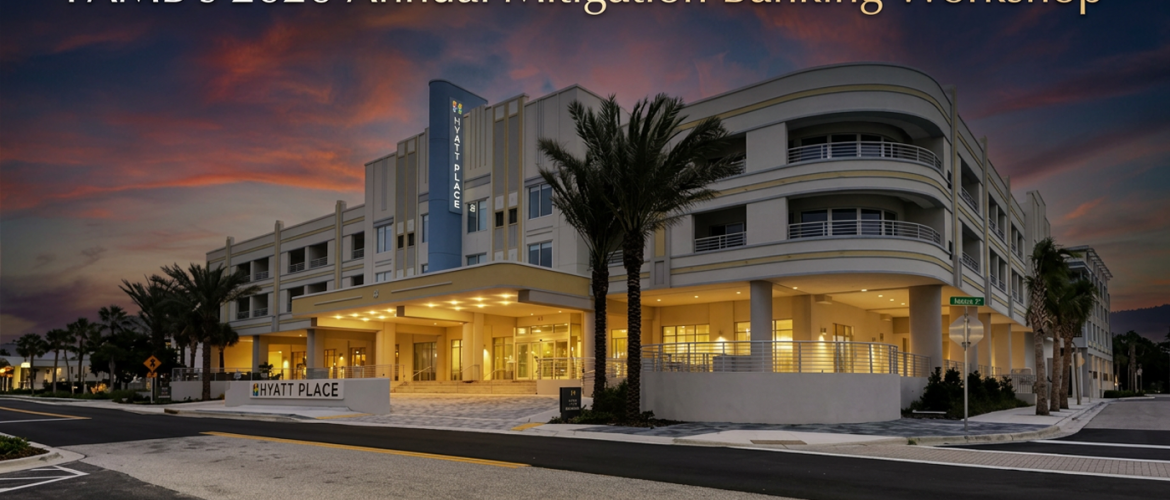
On October 8-9, 2026, The Mitigation Banking Group attended the Florida Association of Mitigation Bankers’ 2026 Annual Mitigation Banking Workshop in St. Augustine. Bankers, regulators, consultants, and conservation partners met at the Hyatt Place St. Augustine/Vilano Beach. MBG was proud to support the FAMB 2026 mitigation banking workshop as a Silver Sponsor and exhibitor.
Over two days, speakers from state and federal agencies, the Florida Wildlife Corridor Foundation, and the private sector shared updates. They covered where Florida’s mitigation banking program stands today and where it is headed.
State Agency Updates
Thursday opened with updates from the Florida Department of Environmental Protection and three water management districts.
Timothy Rach of FDEP’s Division of Water Resource Management reported 23 DEP permitted mitigation banks and four new bank applications. In fiscal year 2025-26, 120.89 credits were withdrawn across 209 transactions. He also covered rulemaking on Chapter 62-332, F.A.C. (Water Quality Enhancement Areas) and Chapter 62-342, F.A.C. (Mitigation Banking).
Lisa Prather, PWS, of the South Florida Water Management District shared cumulative wetland numbers. ERPs have impacted 76,190.61 acres. In return, ERPs have restored 495,938.09 acres, and other district efforts have restored 836,016.37 acres. That adds up to a net gain of 1,255,763.85 acres. She also reported 13 permits issued using the SB 492 proximity factor.
Cliff Ondercin of the Southwest Florida Water Management District reported 51 permitted banks and 11 new banks under review. The district has also received 17 out-of-service-area requests to date.
J. Reid Hilliard of the St. Johns River Water Management District reported 54 mitigation bank permits and 6 ROMA permits. The district recorded 408 credit transactions in fiscal year 2026.
Kelsey Bernard of the Landowner Assistance Program closed out the agency updates. She covered gopher tortoise recipient sites and panther payment for ecosystem services. Both offer financial opportunities for private lands conservation.
USACE Jacksonville District Updates
Steven Currie and Ryan Hendren of the U.S. Army Corps of Engineers Jacksonville District covered the federal side of the program. The district has 104 approved and active mitigation banks, with roughly 14,425 credits available.
Their presentation covered several topics:
- An April 2026 GAO audit of Corps compensatory mitigation oversight.
- A new approach to withdrawing bank proposals when required information is missing for a year.
- The value of an aquatic resources delineation using federal methods, even without a jurisdictional determination.
- The USACE 2005 technical standard for water-table monitoring. The message was to “think shallow” and monitor within 12 to 24 inches of the surface.
Hendren also showed how to enter credit sale withdrawals directly in RIBITS. The Jacksonville District delegated this task to bank sponsors in January 2025. The Corps and FDEP are also looking for ways to reduce overlap between the two programs and speed up reviews.
Conservation, WOTUS, and New Technology
Friday turned to the bigger picture. Jason Lauritsen, Chief Conservation Officer of the Florida Wildlife Corridor Foundation, presented on banking within the corridor. The Florida Wildlife Corridor is an 18-million-acre network of connected lands and waters. About 10 million acres are conserved, and 8 million acres remain. He made the case for mitigation and species banks as a way to close the corridor’s most urgent gaps.
Timothy J. Perry, Esq., gave a WOTUS update. He traced federal wetland jurisdiction from the Clean Water Act through Sackett v. EPA. He then covered the November 2025 proposed rule and the September 2026 supplemental notice. His takeaway for bankers: less federal jurisdiction may mean lower demand for federal credits. Florida’s wetland rules, however, remain broader than the Clean Water Act.
Brendan Brown, PWS, of CDM Smith closed the workshop. He showed how drones and machine learning help monitor and treat invasive species. CDM Smith’s models have mapped more than 20 species across a 100-acre restoration site with over 80 percent accuracy. This helps bank managers find problem areas, target treatment, and verify contractor work faster.
View the Presentations
The full slides from both days of the workshop are available below.
Thursday: Florida Mitigation Bankers Workshop Regulatory Updates 2026
Friday: Wildlife Corridor, WOTUS and Environmental Market Technology
Have questions about how these updates could affect your project or mitigation credit needs? Contact The Mitigation Banking Group for guidance.
Source: Presentation materials from the Florida Association of Mitigation Bankers 2026 Annual Mitigation Banking Workshop, October 8-9, 2026.